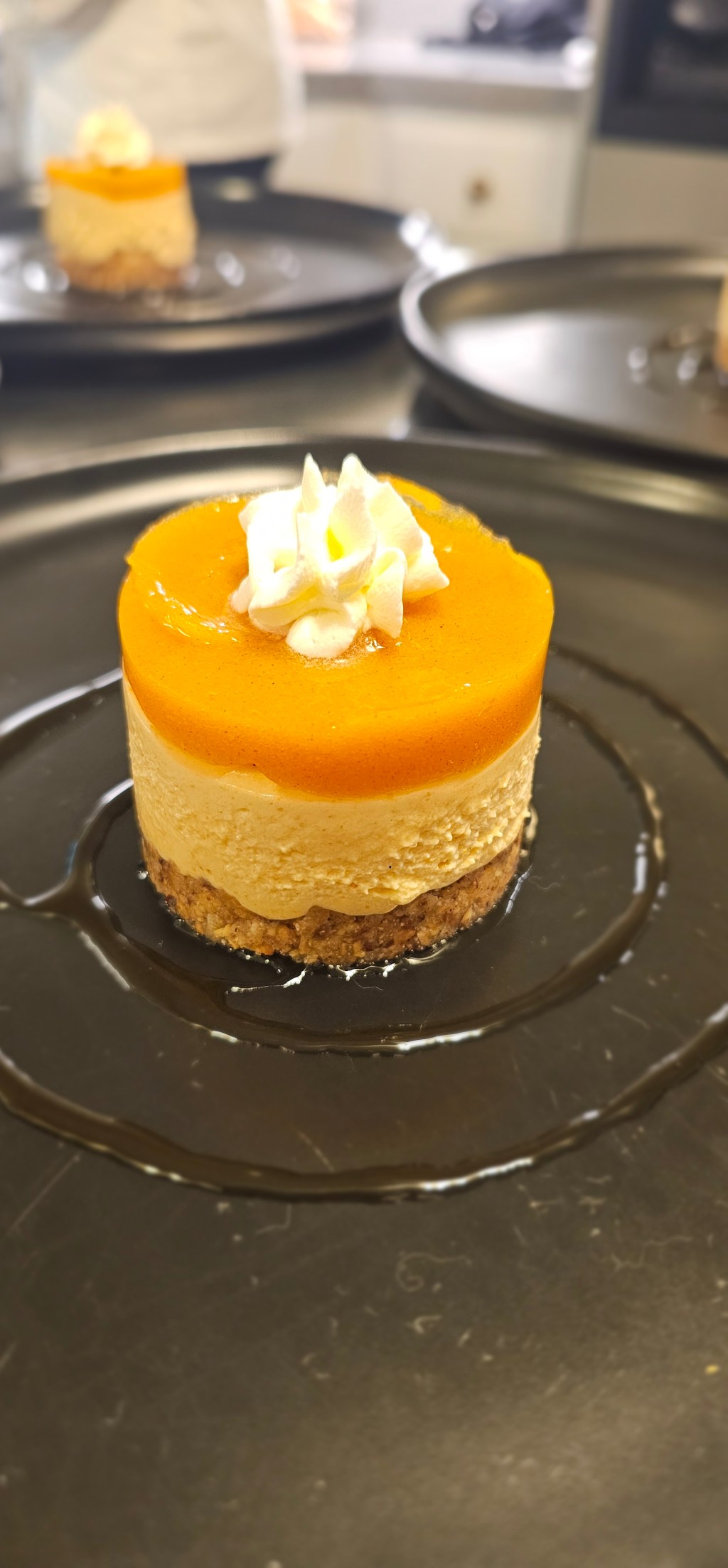
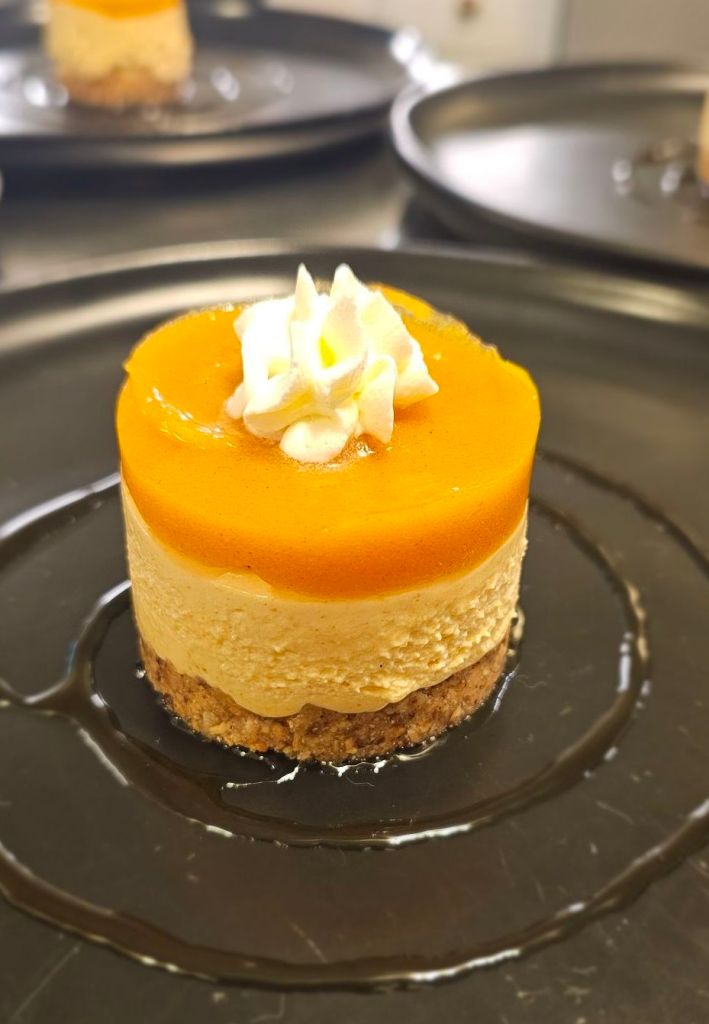
No-Bake Persimmon Cheesecake with Toasted Almond Crust & Persimmon Jelly
Persimmons & Fall. Persimmons are a quintessential autumn fruit — their honeyed sweetness and lush orange color evoke harvest season. When fully ripe their flesh is creamy and floral, making them ideal for no-bake cheesecakes that celebrate fall without heavy baking. This recipe uses ripe persimmon purée folded into a creamy, stabilized filling, an almond crust for toasty crunch, and a glossy persimmon jelly as a finishing topper. Choose acetate sheets for pristine, professional sides or silicone molds for ease of unmolding depending on your presentation.
Ingredients
Toasted Almond Crust
- 1 ½ cups (150 g) toasted almonds, finely ground
- 3 tbsp (38 g) granulated sugar
- 5 tbsp (70 g) unsalted butter, melted (or coconut oil for dairy-free)
- Pinch of fine salt
Persimmon Purée
- 3–4 ripe Fuyu persimmons (about 2 cups / 450 g puréed)
- 2 tbsp lemon juice
- 1–2 tbsp sugar (optional — adjust to fruit sweetness)
Cheesecake Filling
- 16 oz (450 g) cream cheese, softened
- ½ cup (120 g) mascarpone or full-fat Greek yogurt
- ½ cup (60 g) powdered sugar (adjust to taste)
- 1 tsp vanilla extract
- 1 tsp finely grated orange zest
- 1 tbsp gelatin (≈10 g) bloomed in 2 tbsp cold water or 2 tsp agar agar (use manufacturer instructions)
- 1 cup (240 ml) heavy cream, whipped to soft peaks
Persimmon Jelly (Topping)
- 1 cup (240 ml) persimmon purée (from above)
- ¼ cup (50 g) sugar (adjust to taste)
- 1 tsp lemon juice
- 1¼ tsp powdered agar-agar or 1 tsp powdered gelatin (for a glossy, set jelly)
- Pinch of salt
Optional Garnishes
- Toasted almond slices or chopped toasted almonds
- Thin persimmon slices or candied persimmon
- Rosemary-infused whipped cream or rosemary whipped cream (small quenelles)
- Edible gold leaf (optional, for plated dessert)
Equipment & Notes on Molds
Acetate sheets: Use inside metal ring molds (réduits) to get perfectly smooth straight sides. Place acetate inside rings, press crust, fill, chill, then peel acetate away for a crisp edge.
Silicone molds: Ideal for individual portions or domes — they release easily, but the sides will be slightly softer/rounded. Freeze briefly before unmolding for clean results. Acetate gives the most professional square/smooth finish; silicone gives speed and ease.
Silicone molds: Ideal for individual portions or domes — they release easily, but the sides will be slightly softer/rounded. Freeze briefly before unmolding for clean results. Acetate gives the most professional square/smooth finish; silicone gives speed and ease.
Method
1 — Make Toasted Almond Crust
- Toast almonds in a 350°F (175°C) oven for 8–10 minutes until fragrant; cool completely. Pulse to a fine crumb in a food processor.
- Combine ground almonds with sugar, salt, and melted butter until it holds when pressed.
- Press firmly into the bottom of an 8–9″ springform pan lined with acetate, or into individual silicone cavities. Chill 20–30 minutes to set (or freeze 10 minutes for silicone).
2 — Make Persimmon Purée
- Peel and chop persimmons. Purée with lemon juice and sugar (if using) until perfectly smooth. Pass through a fine sieve for a silky purée.
- Measure out 1 cup (240 ml) for the jelly and reserve ~1 cup (240 ml) for the filling (adjust if you have extra fruit).
3 — Prepare Gelatin (or Agar) for Filling
- If using gelatin: bloom gelatin in cold water (2 tbsp) for 5 minutes, then gently warm until dissolved (do not boil). Cool slightly before adding to filling.
- If using agar: dissolve agar in a small amount of persimmon purée or water and bring to a simmer for 1–2 minutes to activate. Cool slightly.
4 — Make Cheesecake Filling
- In a stand mixer or with a hand mixer, beat cream cheese and mascarpone until smooth and light. Add powdered sugar, vanilla, and orange zest; mix until combined.
- Fold in the persimmon purée until evenly incorporated.
- Stir in the dissolved gelatin (or activated agar) thoroughly and quickly so it disperses evenly.
- Gently fold in the whipped cream to lighten the mixture, keeping as much air as possible. The final texture should be creamy, pipeable and hold shape.
5 — Assemble & Chill
- Pour the filling onto the chilled crust (in the acetate-lined ring or silicone molds). Smooth the top with an offset spatula.
- Refrigerate at least 4 hours, preferably overnight, until fully set. For silicone molds, you may freeze 30–60 minutes then unmold and continue chilling for presentation.
6 — Make Persimmon Jelly Topping
- Combine measured persimmon purée, sugar, lemon juice and pinch of salt in a small saucepan.
- If using agar: whisk agar into the purée and bring to a gentle simmer for 1–2 minutes until agar dissolves and the mixture thickens slightly. If using gelatin: warm the purée, whisk in bloomed gelatin until dissolved (do not boil).
- Remove from heat and allow to cool to slightly warm but still pourable. For a glossy jelly that sets to a soft sheen, cool to about 90–100°F (32–38°C) before pouring over the chilled cheesecake.
- Gently pour a thin layer of persimmon jelly over the set cheesecake (or pipe small rounds for plated portions). Refrigerate until the jelly is set, about 30–60 minutes.
7 — Finish & Serve
- If you used acetate, carefully peel the acetate away for a clean edge. If using a springform, release the ring and remove acetate.
- Garnish with toasted almond slices, thin persimmon slices, a small quenelle of rosemary whipped cream, or a scatter of candied persimmon. Serve chilled.
Storage
- Cheesecake keeps refrigerated up to 3 days; best within 48 hours for texture and flavor.
- Persimmon jelly stored separately keeps 4–5 days refrigerated.
- For longer storage, freeze individual portions (without jelly) and add jelly after thawing overnight in the fridge.
Chef Tips
Ripeness: Use ripe but firm persimmons (Fuyu) for best texture — overly soft Hachiya require straining/clarifying to avoid graininess.
Acetate handling: warm acetate slightly with clean hands before peeling to avoid cracking the jelly edge. Peel slowly and at an angle.
Setting agents: agar gives a slightly more jelly-like, vegetarian set; gelatin gives a softer, silkier finish. Adjust quantities per manufacturer guidance and fruit acidity.
Acetate handling: warm acetate slightly with clean hands before peeling to avoid cracking the jelly edge. Peel slowly and at an angle.
Setting agents: agar gives a slightly more jelly-like, vegetarian set; gelatin gives a softer, silkier finish. Adjust quantities per manufacturer guidance and fruit acidity.
“`0

 Admiral's Table
Leave a comment